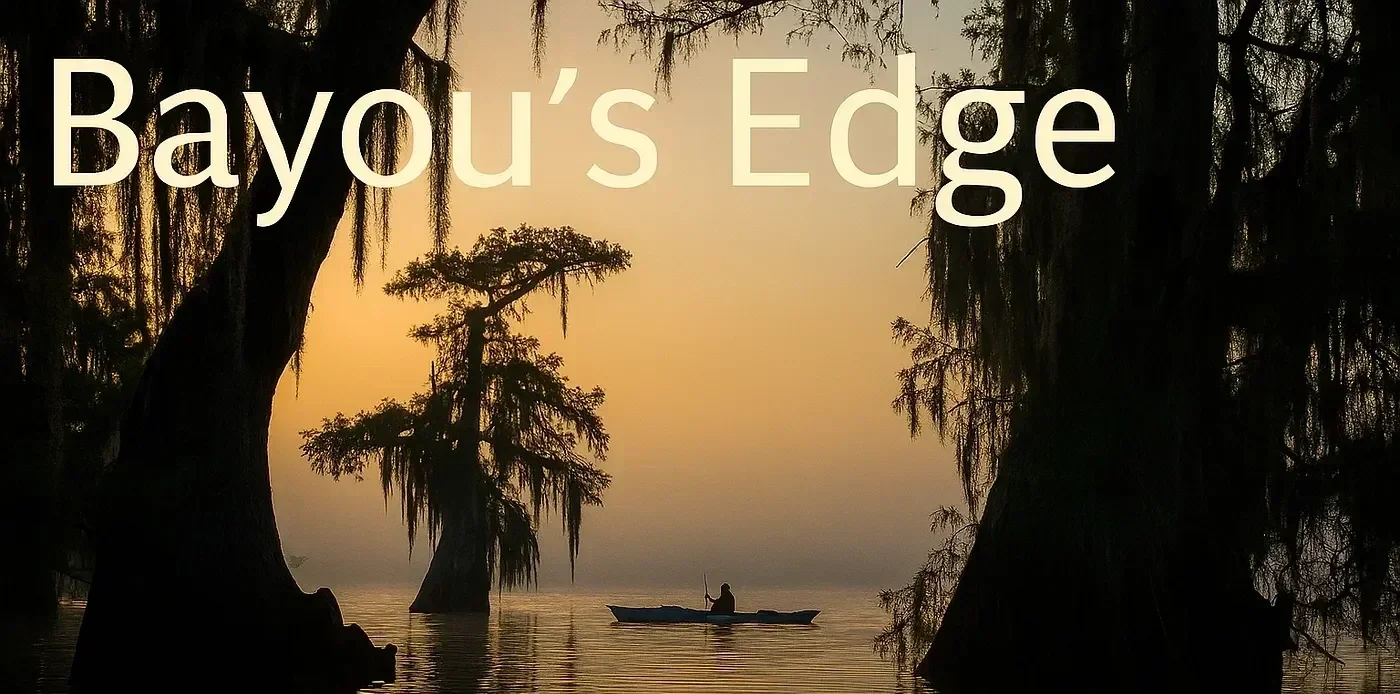
Amidst the sultry paddies and verdant levees of the Louisiana bayous, a crawfish farmer’s dark past threatens to erupt, endangering everything he holds dear.
[This is Part 1of Bayou’s Edge. You can read the full story uninterrupted on Substack, or go to Part 2 on Medium.
Micheau played with chips of white paint on the railing of his soft wooden porch, looking past the outlines of the big oaks his granddaddy had planted, across the long flats toward the road that led in from the highway. A couple was coming to visit, friends of his cousin Isabelle’s in New Orleans. Most days he hardly saw anybody, and by night he was so tired he’d find the quickest place to eat, see the same faces ragged as his, then head back to get up even earlier the next morning, consecutively longer days as the season matured, until it was over in June and he could sleep about a month and then start on the rice crops until they were in and get to the crawfish again.
It was way too early, he realized, some dream had gotten him up before dawn. They were making the drive that morning, time enough for him to get the day started. They were a nice couple, from up North, easy to talk to, and he had a lot to show them.
The light came on in the shack where them Mexicanos was, that was good, they was getting ready without him having to bother them about it, the both of them. A glimmer passed, below where he could say it. Mexican kid, got good work here, then the girl every night. And him here by himself; after a while it got to where your dreams pushed you up too early. Not that he’d envy a Mex. Just work him harder, the both of them. Leave his night thoughts to himself, the way he wanted them.
By six he was jamming the foot pedals that controlled the wheel attached to the long claw behind the boat, pushing through the stubble of the last rice crop until the boat slid across the levee into the muddy water that lay between the long rods of the paddies. It all looked like it was the same until the sun rose and cooked the slivers of water till they glowed red as the crawfish underneath, long burnt slices through the saturated paddy fields with the white dots of the traps to mark the way.
Last month he’d said what there was to be said about the way things got done, so as he and Paco moved down the lines there was only the sound of the motor on the flat aluminum boat special built by the guy just past Lafayette. Paco baited the fresh traps, conical wire mesh with a few inverted entranceways, the craws went in and couldn’t get out, trapped in the watery black hole until they spent some time in the cooler and got seasoned and boiled, all because they were attracted to some cast-off skip-jack’s head or old porgy that was shipped down from the North.
His stiffness wore off with the movement, and he got into the flow of it. He’d pull up alongside a trap, reach down with a straight arm and haul it out, his other hand holding the fresh trap, swivel his body to lay the new one in the water as he put the old one on the square aluminum tray set in front of him. He’d open the top of the trap and dump the craws onto the tray, Paco’d attach a canvas sack and open a small gate. Together they shoveled the crawfish into the sack as he gunned her over to the next white marker. His arms across his body, pivoting, lifting and dropping, it all felt good to him, like the zydeco two step he used to dance for hours. He lived now in the rhythms of the planting, harvesting the upper fields while sowing the lower ones, the alternation of flooding and drying, the joy of dumping a few pounds a trap, dollars dropping into the sacks. The mud was everywhere on him, on his jeans and t-shirt and old black velvet vest, even clinging to his long slick white rubber boots. He pushed to get it done soon, clean up, for the visitors. He thought of Paco washing up for the girl, and yelled at him to get a move on, even though the boy was waiting for him to drive back to the house.
That morning, Micheau had dreamed he saw the slim echo of dawn on all sides of the horizon ringing the fields, and his house in the middle of all the fields, and he in the house, alone as night. The ring collapsed like a dust tail, bearing the spur of their clicks as they scraped against the slide down the ramp into the sack, the tingle of their movements the moment before pricking his fingertips, the splash of setting and raising the traps. He laid near breathless in the dark, reaching for the low vibration of the pump breathing life into the watery fields, till it all got so inside him he had to get up.
* * *
Teddy had wanted to see “real country,” the places that existed first in his mind, so they’d looked for the small roads on the map heading east from New Orleans, gone way south of Baton Rouge, past Thibodaux and Jeanerette and skirting Lafayette, towards Crowley. Deep bayou country, he wanted, as if it would identify itself without their asking. Signs spoke of plantations, but miles away, and they had time to make, so they drove the dreary roads looking for an authenticity they sensed was on either side of them, but never where they were. And of course it was taking much longer than expected.
-We’ll take the Interstate on the way back, he said, conceding to himself as much as her, disappointment parsed mile by mile. Claire was used to it, but that didn’t keep it from being annoying.
So it took her more than halfway out, past the battered gray warehouses and the flat lit corridors of dimmed roadside towns, to finally ask — Are you sure this is such a good idea? She knew his answer because she knew him, but she had to ask just the same.
- Didn’t we go over this? He’s a cool guy, the way he says ‘yes ma’am,’ or ‘yes suh,’ Teddy tried the drawl, lowered his voice, slowed it down, his memory from the brief conversation with Micheau at Isabelle’s the week before. It’s not like Isabelle doesn’t know him. I really want to see this place.
With that, she thought, he still dallied at the sad tourist outcroppings along the coast road, an information center with a rust-shrouded toilet and pictures of a collapsing mansion, the have-to-taste stop at a down home barbecue place of his dreams, where grease coated the downwind tables rattling on the cracked concrete pad next to it. He’d taken to rubbing his just-beginning double chin, having read that would diminish it.
- But those stories about him, Claire rushed to say before his natural tendencies cut her off. It’s all so redneck. She wasn’t ashamed to say it. Her streaked blond hair mingled with her throaty voice, she was no longer cute, but prettier in the way that lived-in things are, like the texture of old brick walls, where looks held the promises that only character and experience could offer.
- We’ll just be there for a few hours. Tourists never get to see this kind of stuff, from the inside. Christ it’s getting late, can we just get there without all this angst? It’ll be fine.
She lowered the sun visor and held her breath as they sped through the thick odor of brackish water. — It’s just low tide, he said. It’ll pass.
* * *
Micheau had half given up and was fixing traps when he saw the dust swarm behind the bright red rent-car as it came up the long driveway and pulled in front of the house. He spoke to the man as he rolled the window down to check if they were in the right place.
- damn I wish you’d gotten here earlier, theys so much to show. Lets get in the truck, we’ll go ‘round. He rolled his r’s so softly they were barely a whisper. The man hopped out of the car. The woman remained in her seat, and Micheau opened the door for her. The man asked what the flock of birds was in the distance, the low sky almost blotted out by the aggregate of spots, were they sparrows, or sea gulls maybe?
- No thats geese, Micheau said.
- That many? the man said, and started taking a picture when all it would be was dots.
- C’mon I’ll get you closer to em. Hey, honey, Micheau called to the shack, and the girl walked out, you know where the bottom is for the burner, we gonna boil up some for folks. She stared at him, her face bronze against the gray light, against the white of her eyes, against her loose white blouse, her expression sharp even in her confusion. Ah hell she don’ understan, she is somethin, though, aint she? Get Paco, will you? The dark handsome boy came out, in his early twenties although the lines on his face were older. Micheau repeated what he was looking for. The boy nodded, went into the tool shed, came out with a metal base and a mottled brown propane hose.
- set it up in front of the cooler, I’ll come back and throw some in. The boy nodded again. The couple followed Micheau into the truck, then he got out, came back with a rifle, which the woman backed away from. Jus to scare away the birds, he said.
- Oh, said the man.
- Don’ want em eatin the profits. The couple tried laughing. The birds can be a real pain, he said. But I don’ kill em anymore, not even for eatin, I don’ like to kill anymore, and thats the truth. He nodded towards the shed as he backed out.
- but I tell you what, them two’s about the best workers I’ve ever had, you ask em to do somethin, they jus up an’ do it. You take your local boys, shee-it — pardon my French, he nodded to the woman, you ask one ah them to say get through that mud, pick up a trap that moved, they jus say ‘no thank you’ and go back home cause they got their food stamps and their government checks. But these kids, the works all they got, or its back to Mexico with nothin, I mean they jus been here two months and that Paco already learned more about the operation than any ah them other boys I’ve had here the past eight years. And Ochandah, I think that’s the way you say it, Ochandah, his senorita or whatever, she’ll work from five in the morning, all the way through, liftin them traps, and man theys heavy, you pull em in all day, hundreds of em, put it down, empty the first and you got to keep shakin and bakin. His arms did the shuffle, one straight out, the other by his side, then quickly shifting positions, thinking of the long loud dances, hoots, whompin and stompin. and the women after, when nothing mattered except what you wanted, until a bounce of the truck pulled him back into their expectant faces. She’ll pull em up all mornin and day, the mud’ll be on her like caramel sauce on chocolate ice cream, and she keeps smilin and pullin. Man, thats somethin, aint it?
He drove the old pickup, not the new blue one he’d bought to make deliveries, over the thin strips of land in the middle of the rice fields, the afternoon sun sketching the water in gray reflections sprinkled through the brown remnants of the last crop. Eight years ago Micheau came back to take over the farm after his granddaddy passed, and he had the idea to harvest the crawfish that thrived in the nurtured fields along with the rice, and was now selling hundreds of pounds each day in the bayou towns of Southern Louisiana.
He pointed to a white cone. Thats for my pump, he said, got to keep aeratin the water, keep the oxygen in it, I’m pumpin from way back over there, got it all underground.
- How much land do you have? the man asked.
- Its five hundred thirty six and two thirds acres, Micheau said.
- How come two thirds? the man asked with a laugh.
- Well I don’ know it’s the way I got it, he said.
The path was wide with tiny water pools in the indentations left by tire tracks which were strips of mud through the low green grass. — This here used to be a landing strip, he said, you can land jus about most anything along here.
As they approached the fields he slowed down, and the man unlatched the door. — Hold on, Micheau said, when he jumped out of the truck to get a closer look, but the thousands of birds took flight as if with a single mind, pure white snow geese, that the couple had never seen before, and blues, they filled the sky and the sound surrounded them as they circled, first away, then back over them and then around again, some squawks but mostly the fluttering of wings like the rumble of waterfalls until they landed in a more distant field. The man grabbed for his camera, then put it down.
- hell, used to be you couldn’t even get that close, Micheau said, never mind we’ll come around and see em again. Its jus two years maybe they’ve gotten used to the trucks what with nobody shootin at em, probably forgotten what it sounds like. The man said when they were on safari in Kenya the game had gotten so accustomed to human presence without hunting that it would let you drive up so close an elephant peed on their Land Rover. Is that right? Micheau said, now look, see them other ones over there by themselves? Thems speckled bellies, they stick to their own. They could see the blues and whites like shards of broken plates while the speckled bellies, shades of brown and tan, strutted in a loose pack in a separate part of the field.
- look at them specks, aint they beautiful? You take off their feathers and clean ’em, their flesh is jus pink, theys the best goose in the world for eatin, see how they stay away from the others, damn that jus makes me want to weep. He picked the rifle up, sighted and mock fired, his finger pulling alongside the trigger. The couple stood still. The man stirred to break the silence, and Micheau put the gun down.
He turned the truck around, said, go on now you can get out. The couple walked gingerly, him in canvas tennis sneakers and her in black pumps that squished a little as the mud grabbed at her heels. They watched the geese, shooting their heads into the wet grass clumps or picking at their bodies, crowding and releasing each other, the specks resting more calmly, as if they couldn’t be bothered. They got back in the truck and headed for the house.
- I heard… I heard you had some wild times, before you moved here… the man left the opening.
- I tell you what, Micheau said, that was a time ago, a real different time. He downshifted the truck so that the loose tools under the seat thumped beneath them. The narrow back seat forced Claire to lean forward.
- Isabelle said you were a great dancer, the man tried.
- Did she? well, that must be true then, don’ seem to get much time for it out here though. He worked to keep the steering wheel from spinning as they made way over the damp ground.
- What kind of trees are those, by the house? the woman asked, the trees along with the sheds and shacks all they could see above the rustling line of the land.
- Oak trees, I reckon theys about the most beautiful trees in the world. The couple looked at him. Or the state of Louisiana, anyway.
They drove over a large square concrete foundation. — Some old building? the man asked, thinking he was showing that he would know there wouldn’t be basements in this kind of country.
- it was for the landing strip, I leased it to this guy, planes comin in at night all the time, he was CIA or somethin. He was jus trouble, I told him I didn’t want him anymore, then two weeks before the lease is up this place burns down. I know it was arson, everybody does. Then I hear he was tryin to hire someone to do me, and they got the guy, hell, had him in my house, with the sheriff and the assistant district attorney, and he said he was approached to do me, thats what he said to the both of them, that the guy asked him how much would it take, five grand, ten, fifty, he told it to em both, and then they get some phone call the next day and they do a total of nothin about it.
The couple stared at the concrete until it was behind them. — So, the man said, who do you sell the craws to? He almost said crays, but caught himself, he’d made that mistake enough in New Orleans.
- I sell to them Frenchies, they got a few restaurants, all within fifty miles of here, they pay cash, don’ need no Uncle Sam in this business, no sir, they tried to come down here and get on top of it but they can’t, I get a dollar twenty-five a pound most all of the time, except when theys jus too much product, everybody bringin it in at the same time, you only get eighty cents from the big factories around here, so I deliver direct, sometimes someone tries to get to my customer, thats when I get competitive you damn sure, but all they have to do is look in my sacks, cause I got the best product. But it aint no business of Uncle Sam.
As they made the last turn Micheau stopped the truck and walked to the water to check if the pump line was clear.
- You see, I told you, everything would be cool, the man said.
- What time do you want to head back? she asked.
- I was thinking, I’ll bet there’s some good places around here, remember the Cajun goose he brought for Isabelle’s birthday party? And that venison.
-We’re having dinner out tonight, we just have one more night after this. I want the time with Isabelle, she invited some of the other gallery owners. I’m not missing it.
To continue the story, read Part II: Bayou’s Edge — The Past Is Present → [link].