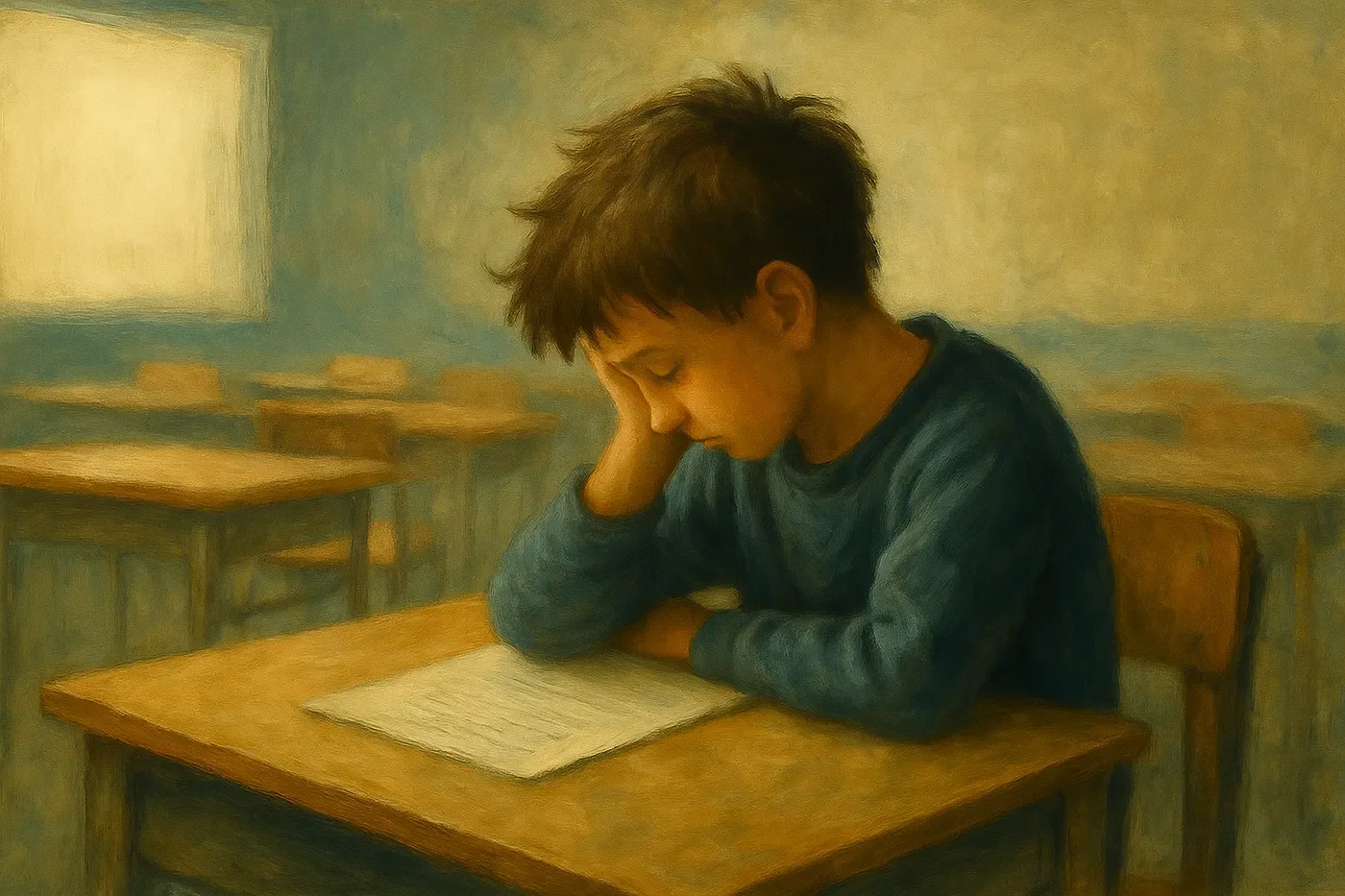
What I learned teaching in a system that funds failure.
It was my first day with my new fifth grade class.
We walked into a classroom filled with what someone far away in their wisdom thought a good idea: movable desks and chairs.
I asked the class to take seats. All but one did. She was skinny as a rail, had coke bottle lens glasses, slightly buck teeth, and a dozen books clutched to her chest.
“Wanda,” I said, “please sit down.”
There was a moment of silence. She stared at me. Then she threw all her books to the floor, shouted “Fuck you,” overturned a desk and chair, and ran out of the room.
My year with them had begun.
That was my first week teaching in New York City. I thought I was there to help students who had somehow “fallen behind.” But the longer I taught, the clearer something became:
These kids weren’t failing. They were being failed.
The year was 1968. I’d just finished college, written a political science paper on education, and with the draft looming, joined an organization that placed new teachers in New York City’s public schools, to live in the neighborhood where we taught.
I got placed in the Two Bridges area of Lower Manhattan. That fall the city’s teachers went on strike over the issue of community control of schools, which the union opposed. I and my fellow teachers in our program supported the local community, so I spent the first 9 or 10 weeks of my first job post-graduation crossing a picket line, being yelled at as “scab” by some suddenly feral looking grade school teachers.
I was rewarded for crossing the picket line by being given a class of fifth graders whose behavior was deemed as not allowing the other fifth grade classes to function. “A dirty dozen” already labeled as lost causes at ten years old.
One of them was Wanda Rodriquez.
I learned a lot that year. About our education system and what it does to kids who are inherently wonderful.
Decades later, the same truth still holds: most students are doing poorly, not because they can’t learn but because the system doesn’t teach them.
Despite so many years of so-called educational reforms, the system still produces waves of students unable read, write, do math, or reason at appropriate levels. They lack the critical thinking skills to distinguish fact from fiction, truth from propaganda, big ideas from big lies.
Doing the same thing over and over and expecting different results is the definition of insanity — and also of our education system.
In New York City alone, more than a million children cycle through a system that destroys opportunity year after year, a systemic destruction of a group and its future. The consequences are profoundly tragic.
Teaching that year was rough going! That spring, I brought in some games and puzzles — paid for out of my own pocket, since the school wouldn’t. One was an African marble game, with complex rules for moving pieces across a carved board.
Ignoring the usual chaos, Wanda became fascinated with the game. For three days, she sat engrossed at her desk.
On the third day, she looked up and smiled — a radiant, transforming smile — as she pointed at the board, the marbles moved to their winning position.
When I asked how, she demonstrated the complex series of moves, her thin hands dancing across the board, joy flooding her face. I nearly had tears, told her what a magnificent job she had done. The best part of it was my praise was redundant.
Wanda then finally opened one of the many books she carried like armor and devoured it, and the math problems and the reading, like rain had fallen on parched earth so that the dormant seeds bloomed.
At the end of the year, I persuaded the administration that Wanda deserved to be in the top track, 6–1, not the remedial 6–5 in which she would have been doomed.
Wanda’s story is not unique. Most students have what she had: latent potential, crushed by a system that doesn’t recognize it.
Across the country, the numbers tell the same story.
National nationally, only one-third of 4th and 8th graders read at grade level. In math, just 26% of 8th graders meet basic proficiency. In New York City, where I taught, reading proficiency drops from about 50% in 3rd grade to under 30% in 8th grade.
And this hasn’t suddenly happened. The NAEP — the nation’s report card — shows decades of decline. COVID accelerated a collapse that was already happening.
These numbers aren’t abstractions, they have impact. Of the million kids in NYC’s public schools, on graduation nearly 50% are deemed “not college ready,” and only 200,000 will make it through college.
So it’s not surprising that some politicians now argue we should abolish the U.S. Department of Education altogether. When a system performs this poorly for this long, people lose faith.
But the truth is simpler, and harder:
It’s not the students who are failing. Saying that is like blaming the victim. It’s the schools, teachers, and systems that are failing them.
In two years, I and my fellow teachers taught hundreds of students in some of the city’s poorest areas. I can count on one hand the number who were truly unteachable.
The rest were fully capable of learning — given the right teacher, attention, and expectations. The numbers tell how few of them achieved what they could.
So please don’t castigate me for saying we should seek alternatives.
Advocates of public schools call for longer school years or more funding — which is like praying for twenty more seconds on a plane that’s crashing. While unions fight any proposals for systemic change, much as so many teachers want to help their students.
New York City spends approximately $32,000 per student per year.
Imagine: for 20 students, that’s $640,000!
With that, you could hire a great teacher for $150,000 a year (vs. the average salary of $65,000 NYC teachers make), a first-rate teaching assistant for $100,000, buy every child a laptop and good software. You could feed them healthy meals and take them on trips that ignite curiosity.
You could rent beautiful space in the city’s empty offices, install a state-of-the-art audiovisual system, pay an excellent principal to oversee 10 such classrooms, and you’d still be saving taxpayers over $5000 per student, or $5 billion a year in New York City, while delivering radically better education.
Other systems around the country may have lower numbers, but adjusted for cost of living, all are comparable.
We are funding failure.
Think of every 5-year-old you’ve known, curious, enthusiastic, with an innate hunger to learn. Then watch as the school system drains their spark.
Their creativity eviscerated.
Curiosity squashed.
Talents neglected, shrunk to fit some irrelevant tests designed to perpetuate funding.
Creativity and passion destroyed, futures cramped down.
By a system that should be nurturing them. Crushing what it’s paid to cultivate.
We tolerate societal structures that squander human potential. Throw billions into epically failing systems that destroy futures.
Doesn’t that make you angry? It infuriates me.
Especially when there are clear solutions to unlocking our children’s futures.
“You may say that I’m a dreamer,” Lennon sang. But don’t we need better dreams for our children?
Until we stop rewarding systems that don’t work, and start funding what does, our classrooms will keep producing students we accuse of failing.
It’s not they who are failing.